I Am Becoming: The 4 Character Traits Jiu-Jitsu Builds in Your Child
There is a mirror on the wall at Team Randori Martial Arts in Annapolis. Most people catch their reflection in it on the way to the mat, still tying a belt, filling a water bottle, laughing with a training partner. Printed across that mirror are four words under one heading:
I AM BECOMING…
Confident – I believe in myself.
Disciplined – I do what is right.
Resilient – I keep going.
Respectful – I treat others well.
We chose the word becoming on purpose. Nobody walks through our door already finished, not the five-year-old on their first day and not the adult who hasn't done a forward roll since grade school. Character isn't something a child has or doesn't have. It's something they build, one class at a time, the same way they build a strong guard or a clean escape.
If you're a parent looking at martial arts because you want more than exercise for your child, if you want them to grow into someone who stands tall, follows through, gets back up, and treats people right, this article is for you. Here's how Brazilian Jiu-Jitsu builds each of those four traits, and what it actually looks like on the mat.
Why Character Has to Be Trained, Not Told
Every parent has given the speech. Be confident. Don't give up. Be respectful. Kids nod, and then real life tests them and the speech evaporates.
That's not a failure of parenting. It's how people learn. Character is a skill, and skills come from repetition under a little bit of pressure. You can't learn to swim from a lecture, and you can't learn resilience from one either.
Jiu-jitsu gives children a safe, structured place to practice character dozens of times per class. Every round asks them a question: What will you do when it gets hard? And every round, with a coach beside them, they get to practice a better answer.
Confident: "I Believe in Myself"
Confidence built on evidence
There's a difference between being told you're great and knowing you can do something. The first kind of confidence cracks under pressure. The second kind holds.
Jiu-jitsu builds the second kind. A child learns an escape. They drill it slowly with a partner. Then one day, in live training, someone holds them down and they get out, on their own, with their own technique. Nobody handed that to them. They earned it, and they know it.
That's evidence-based confidence. It shows up later in the classroom, on the sports field, and in the moment a child has to speak up for themselves.
Confidence without arrogance
Parents sometimes worry that martial arts will make a child cocky. In jiu-jitsu, the mat keeps everyone honest. There is always someone more skilled, a bigger kid, an older belt, a coach, and everyone gets humbled regularly. Children learn that confidence and humility can live in the same person. In fact, the strongest people on our mat are usually the quietest ones.
Disciplined: "I Do What Is Right"
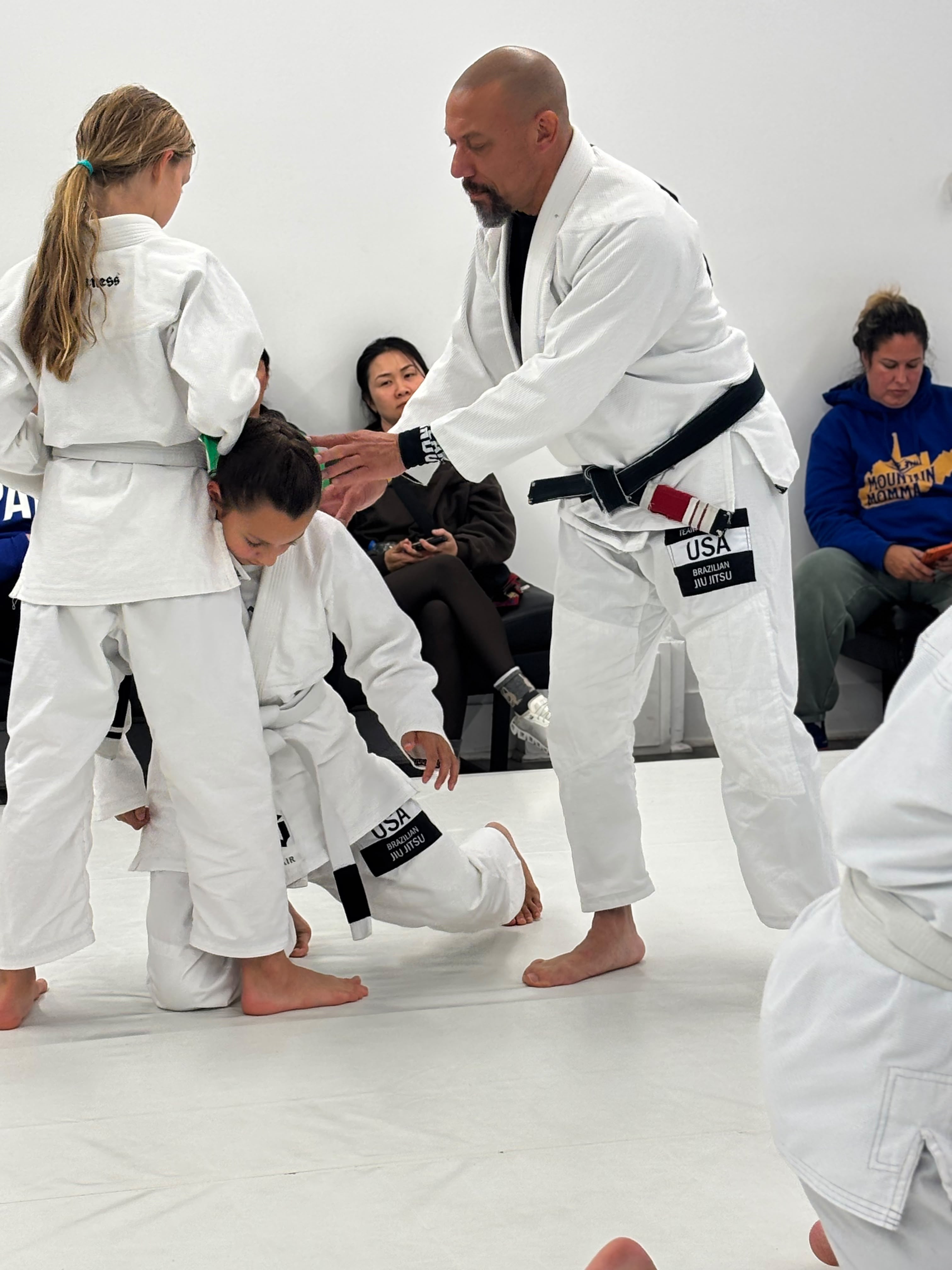
Discipline is a hundred small choices
Look at the photo above. A coach is adjusting one detail of a young student's position, where her head goes, where her hand goes. It's a small thing. That's the point.
Discipline in jiu-jitsu isn't about yelling or rigid drills. It's built from small, repeated choices: line up on time, listen when the coach is talking, drill the move the right way even when no one is watching, tap when you're caught instead of fighting a losing position out of pride.
Our motto says "I do what is right," not "I do what I'm told." That difference matters. We want kids who make good decisions because they understand why, not just because an adult is in the room.
Self-control under pressure
Jiu-jitsu is one of the few activities where a child is physically challenged and has to stay in control at the same time. They learn to apply a technique with care and stop the instant a partner taps. They learn that strength comes with responsibility. That lesson about power and restraint is one many adults wish they had learned earlier.
Resilient: "I Keep Going"
Every round is practice at getting back up
In jiu-jitsu, your child will get stuck in bad positions. They will get swept, pinned and tapped. Every single student on our mat, including every black belt, has been through it thousands of times.
Here's what I tell parents: that's not the downside of jiu-jitsu. That's the gift.
Each tough round is a small, safe dose of adversity. A child feels frustrated, takes a breath, resets, and tries again. Over months, something changes. The frustration doesn't disappear, but it stops running the show. They learn that a setback is information, not a verdict.
The inner warrior shows up quietly
People picture a warrior as loud and fierce. On the mat, the warrior spirit usually looks calmer than that. It's the child at the bottom of a pin who stays patient, protects themselves, and waits for the opening. It's the kid who lost a round last week and lines up again today with the same partner.
That's the kind of toughness that carries a person through a hard school year, a cut from a team, or a friendship that falls apart. It's not about never falling. It's about knowing you can get back up.
Respectful: "I Treat Others Well"
You can't train without a partner
Jiu-jitsu can't be practiced alone. Every technique your child learns needs a partner who trusts them. That builds respect into the activity itself.
Children learn to bow onto the mat, shake hands before and after rolling, look after a smaller or newer partner, and thank the person who just beat them. These aren't rules stuck on top of the training. They are how the training works. If you hurt your partners, soon no one wants to train with you. Kids figure that out fast.
Respect for others and for themselves
Respect runs both ways. As kids grow more capable, they also learn to expect respect. A child who knows how to hold their ground physically tends to carry themselves differently. They make eye contact. They set boundaries. They're less likely to be picked on, and far less likely to be the one doing the picking.
What Parents Can Do at Home
The mat does a lot of the work, but you are still your child's most important coach. A few simple habits help the lessons stick:
Ask about effort, not results. Instead of "Did you win?" try "What was hard today, and what did you try?"
Use the four words. When your child keeps going on a tough homework assignment, name it: "That was resilient." Kids grow into the words we give them.
Let them struggle a little. Resist the urge to rescue them from every frustration. The struggle is where the growth is.
Show up consistently. Character is built through repetition. Regular attendance matters more than any single great class.
Becoming Starts With One Class
The word on our mirror is becoming because the journey never really ends, for kids or for adults. The five-year-old learning to tie a belt and the teen earning their next stripe are on the same path. So is the parent sitting on the bench who's thinking about joining an adult class.
If you want your child to grow more confident, disciplined, resilient and respectful, the best way to see whether jiu-jitsu is a fit is to try it. Team Randori Martial Arts offers a 30 Day Trial Membership for kids, and your child receives a free BJJ uniform the day they start. Kids classes run Monday, Tuesday, Thursday, Friday and Saturday.
Book your child's first class at Team Randori and let them start becoming.
See you on the mat,
Coach Al
Team Randori Martial Arts, Annapolis